You are spending money to make the phone ring, and some of it is working. A form gets filled out. Someone calls and asks about pricing. There is real interest coming in. And then, somehow, the calendar still looks soft on Monday morning.
It is a maddening place to be, because every report you get says things are working. Impressions are up. Cost per lead looks fine. The marketing company sends a dashboard with green arrows. But green arrows do not pay rent. Booked appointments do.
Here is the part worth sitting with: for a lot of practices, the bigger issue is not how many leads come in, it is how many of them get followed up with well. Some practices genuinely need more traffic. But almost all of them are losing a portion of the interest they already have, somewhere between the inquiry and the booked appointment. That gap is usually cheaper and faster to fix than anything else, which makes it the right place to look first.
The leads are fine. The minutes after are the issue.
When someone fills out your form or calls about a treatment, they are at the most interested they will ever be. They are sitting there, phone in hand, ready to be convinced. That window does not stay open.
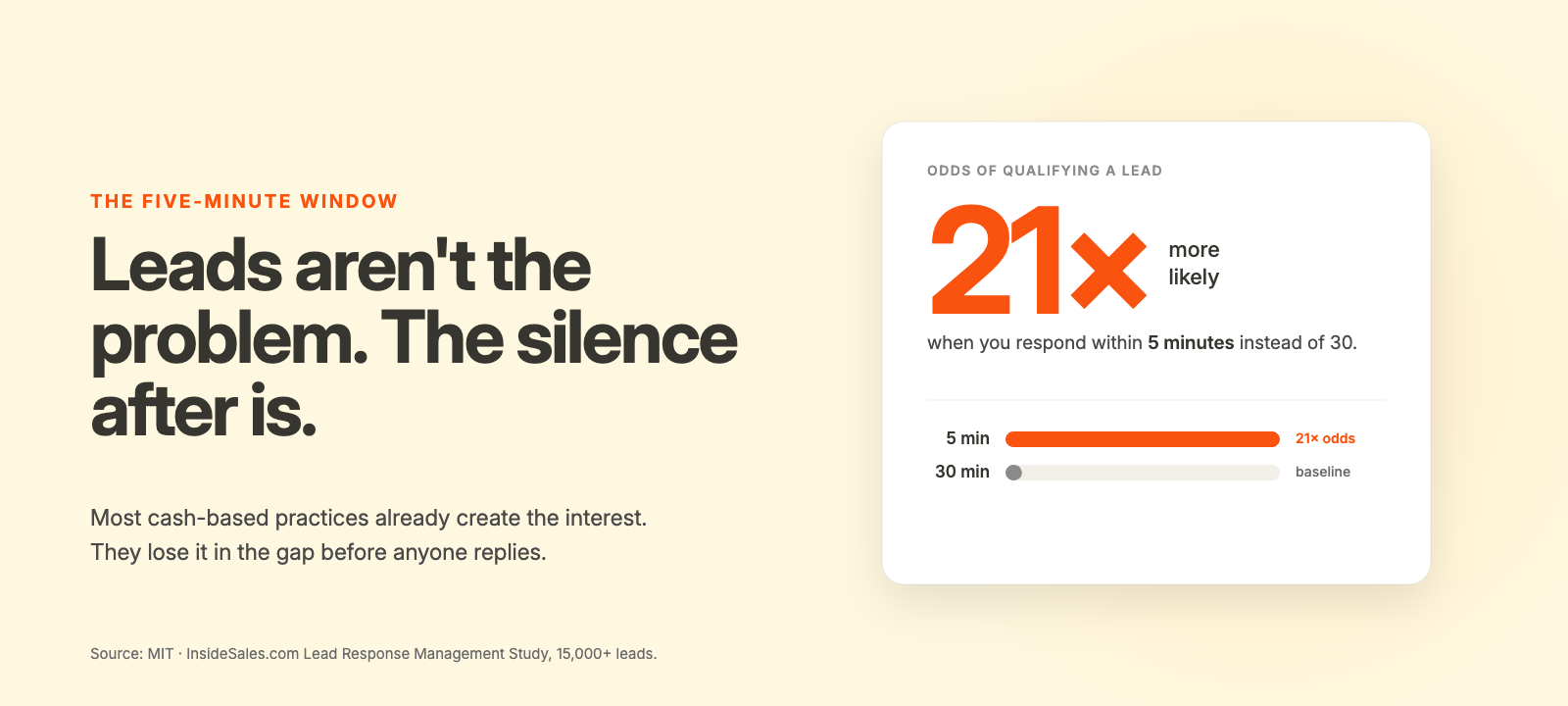
The most cited research on this comes from the Lead Response Management Study, run by Dr. James Oldroyd at MIT with InsideSales.com, which analyzed more than 15,000 leads. It found that the odds of qualifying a lead are 21 times higher when you respond within 5 minutes versus 30 minutes. Not 21 percent higher. Twenty-one times. A separate Harvard Business Review study of millions of leads found that companies responding within an hour were roughly 7 times more likely to qualify a lead than those who waited just 60 minutes longer.
Read those numbers against how your practice actually runs. A patient inquires at 2pm. Your front desk is with a client. The message sits. Someone gets to it at 5pm, or the next morning, or never. By then the patient has moved on, or booked with the clinic down the road that called them back in four minutes.
This is exactly the gap Brandpunch's AI systems are built to close: responding the moment someone raises their hand, around the clock, before the patient moves on to the practice that answered first.
The lead was never the problem. The three-hour silence was.
Where the bookings actually disappear
It is rarely one thing. It is a series of small, ordinary gaps that each lose a few patients, and together drain most of the demand you paid for. The usual culprits:
The slow web inquiry. Someone fills out your form at 9pm. Nobody sees it until the next business day. The faster a competitor responds, the more of your leads quietly become their patients.
The missed call nobody recovers. Your front desk is busy, the phone rings out, and that call is just gone. No text back, no callback, no record that someone wanted to give you money. For a cash-based practice, a missed call is often a missed several-thousand-dollar treatment.
The patient who asks about price and vanishes. This one feels like a pricing problem. It almost never is. It is a follow-up problem, and it is common enough that it deserves its own breakdown, which is coming in a separate piece.
The old leads sitting untouched in your system. You have a database full of people who inquired six months ago and never booked. Most practices never contact that list again. It is the cheapest pipeline you will ever have, and it is sitting there going stale.
The reviews you ask for at random, if at all. New patients check reviews before they book. If yours are thin or old because nobody has a system for requesting them, you lose people before they ever call.
Notice what all five have in common. None of them is a lack of interest. Every one of them is interest that showed up and then got dropped.
Get the follow-up right before you scale the traffic
When the calendar is soft, the instinct is to turn the marketing up. More leads in, more appointments out. Often that is exactly right, and some practices do need more volume at the top.
But there is an order of operations. If you are only converting a fraction of the interest you already generate, scaling traffic first means you pay to lose more of it the same way. Every new lead runs into the same slow follow-up, the same missed calls, the same silence. Tighten the response first, and every dollar of ad spend after that works harder, because more of the traffic it buys actually turns into booked patients.
The practices that win are doing both: bringing in enough of the right traffic and converting it cleanly. The mistake is scaling one while ignoring the other.
What fixing it actually looks like
The good news in all of this: the gap between interest and booked is the most fixable part of your whole operation. It does not require a bigger budget first. It requires systems that catch the interest you are already paying for, before it cools.
That means responding to every inquiry in minutes, not hours. Recovering every missed call automatically, with a text that goes out before the patient has dialed the next clinic. Working your existing database instead of letting it sit. Asking for reviews on a schedule instead of a whim. None of it is glamorous. All of it is where your next twenty appointments are actually hiding.
This is the entire reason Brandpunch exists. Brandpunch builds AI systems for cash-based practices ready to turn interest into real results, moving people from curious to booked, and from booked to growth that moves the bottom line. Not more attention. Better conversion of the attention you already have. You can see how that works on what we do.
You already paid for the interest. The only question is whether you are going to keep letting it walk out the door.